
Every November the internet turns into a shouting match: “50% OFF!”, “LOWEST PRICE EVER!”, “ONLY 3 LEFT!” Some of those deals are genuinely good. Some are the regular price wearing a party hat. The trick is telling them apart without spending your whole evening on spreadsheets.
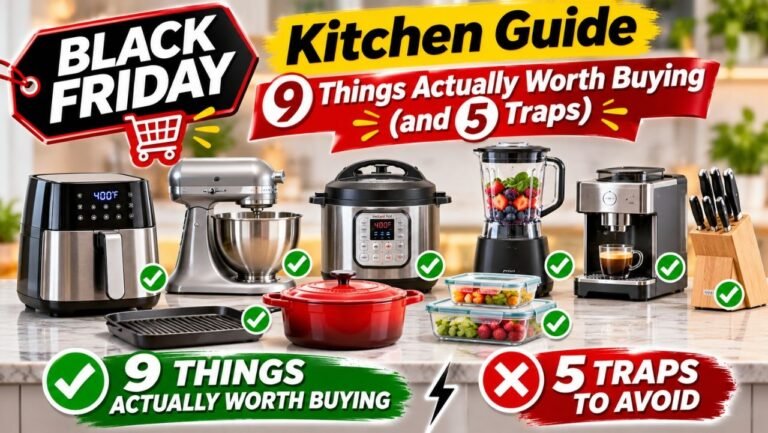
This is a five-step check that takes about two minutes per product. It works for kitchen gear, which is what we love here, and for pretty much anything else with a price tag. If you are still deciding what to buy, start with our Black Friday kitchen guide first and come back here before you pay.
Step 1: Look at the Price History
A discount means nothing without context. Free price trackers such as CamelCamelCamel and the Keepa browser extension show how the price of an Amazon listing has moved over weeks or months. If the “sale” price is the same as it was in September, you have not found a deal, you have found a banner.
What you want to see is a clear dip below the usual price. A small dip on a product that is often discounted is normal. A big dip on something that rarely moves is the good stuff.
Step 2: Question the “Was” Price
Many listings show a crossed-out price next to the sale price. That crossed-out number is whatever the seller chooses to call the original price, and it is not always a price anyone actually paid. Ignore the percentage and look at the final number instead. Would you pay that on a normal Tuesday? If yes, great. If not, the percentage is just decoration.
Step 3: Check the Exact Model Number
Some retailers carry versions of a product that are sold mainly during big sales events. They can look nearly identical to the regular model but come with slightly different specs, accessories or materials. It is not always bad, but it means “same product, cheaper” is not guaranteed.
Compare the full model number, not just the name, with the manufacturer’s page or a second store. If you cannot find the exact number anywhere else, treat that as a yellow flag and read the product details more carefully.
Step 4: Read the Newest and the Worst Reviews
Sort the reviews by newest first, then read a few of the one-, two- and three-star ones. Five-star reviews tell you the product can work. The lower ones tell you how it fails: peeling coating, a lid that does not fit, a motor that quits after a few months. You are looking for patterns, not one grumpy person.
Also be careful with products that have a huge number of reviews bundled in from a different item or that suddenly jumped to a perfect score. If the review dates look suspicious, trust your own caution.
Step 5: Add Up the Real Cost
A cheap price can get expensive fast. Before you buy, check the return window, shipping costs, whether the seller is the store itself or a third party, and what the warranty covers. Add anything you will need to make it work, such as filters, special pods or replacement parts. The real price is the total, not the number in big red letters.
A Quick Example (With Made-Up Numbers)
Say a stand mixer shows $299 crossed out and $199 as the sale price. Your price tracker shows it usually sits around $219 and dipped to $189 last spring. So the big “save $100” label is really a $20 saving, and not even the lowest price it has ever had. You can wait for a better dip, or you can decide that $199 is fine because you will use it every week. Either choice is good, as long as you make it with your eyes open. These numbers are invented for the example, so check the real ones for the item you want.
Check the Store Policies Before You Buy
Return and price-adjustment rules vary from store to store, and they often change during the holiday season. Some retailers extend the return window for holiday purchases, and some will refund the difference if the price drops soon after you buy. Others will not. A thirty-second look at the policy page is worth more than a coupon code, because it tells you what happens if the product arrives broken or simply is not for you.
Red Flags That Should Make You Pause
- A countdown timer that resets every time you reload the page.
- “Only 2 left!” on an item that has said “only 2 left” for weeks.
- A brand you cannot find anywhere else, with no website and no contact details.
- A price that is much lower than every other store for the same model.
- Pressure to decide right now. Good deals rarely need you to panic.
Make the Sales Work for You
The calmest way to shop is to decide before the sale starts. Write down the two or three things you actually need and the highest price you would pay for each. When the sale arrives, you are not browsing, you are checking. If a product clears your price, buy it. If it does not, you have just saved money by doing nothing, which is the best kind of kitchen hack.
A simple rule helps too: add the item to your cart, then wait 24 hours. If you still want it tomorrow and the price is still good, buy it. If you forgot what it was, you did not need it.
A Two-Minute Checklist
- Price history looks like a real dip, not a flat line.
- The final price is one you would pay on a normal day.
- The model number matches the regular version.
- Recent reviews and low-star reviews do not raise red flags.
- Shipping, returns and warranty are clear.
If you can tick all five, go ahead and buy it. If you cannot, there will be another sale. There always is.
Shop Slowly, Cook Happily
Black Friday is loud on purpose. A slow, boring check beats an impulse buy every time, and your kitchen will thank you for the gadget you needed instead of the one that was blinking the loudest.
Which Black Friday trick has saved you the most money, or which fake deal almost got you?
Get the Lazy Kitchen Rescue Kit
3 cheat sheets for your fridge: quick fixes for kitchen fails, air fryer times and temps, and emergency ingredient swaps. Free, straight to your inbox.


[…] check the return window and add shipping to the total. If you want the full routine, read our five-step check for real vs fake Black Friday deals. Prices and stock change quickly, so check the current price before you […]